Saturday, June 11, 2011

Part 28: Ghost Soldiers becomes The Supernaturals production

Foam Latex needs to "vulcanize" or cook at a minimum of 140 degrees Fahrenheit for it to be "set".  Generally, this is done in a relatively expensive industrial oven and they can range in size from smaller models that are used for baking small prosthetic molds, to giant ovens that larger studios use for larger projects.  Neither big, nor small, Mark's studio, alas had not an oven large enough to bake our foam-latex fabricated suits.  So, what to do?

Mark and I, when we were living in a house in East Pasadena, had success by "building" a make shift oven using a plywood box, aluminum foil, bricks, heat lamps and a fan.  If it ain't broke, don't fix it.  Utilizing an open but vacant room in the building, we would creep in after hours, "build the oven" and then bake the foam all night only to disassemble the oven and return everything to it's proper appearance by the morning.

The oven is set up, ready for action!
Ahhhh, baked to perfection!  Note the thermometer on the post to the right.
We did the same thing for the gloves.  Using the hand casts we pulled spandex gloves over them, spatulated foam latex onto them, and baked them in the box-oven.  The task of painting most of the actual suits fell to me.  Mark designed a paint scheme that he wanted followed on all of the pieces and as the masks were painted, they were assigned to the bodies and then the paint was tied together.

Pax painting suits.
Foam latex glove is painted and nails glued onto it.
We all spent time molding head sculptures as they became available. Since we knew that they would be run in casting latex, all of the head molds were made with Pottery Plaster.

Ed and Bart at the molding table.
For some reason, I recall that we made molds two at a time.
And as the molds were completed, it was time to clean them.  Bart looks a bit tired of cleaning molds!
The wardrobe department sent over some uniforms for the Ghost Soldiers, but not only were they the incorrect color, but they weren't up to the standards that we were striving for.  Mark called in a friend of his, Lisa Jensen, who made and aged all of the costumes.

Since she worked so closely with the individual suits, she was able to design the tattered clothes in a way to hide seams, joins, and other construction challenges.

The suits are lined up, ready for final paint and assembly.
Bart's Ghost Soldier gets its wardrobe.
As the shooting day drew near, we prepared set kits that we'd need for the application and maintenance of the suits and effects on location.  Before fluorocarbons were reduced due to their environmental impact, there used to be a silicone-based medical adhesive known in the industry as "355."

"355" was very expensive and would be thinned with tri-fluoro tri-chloroethane (not sure if that is spelled correctly, sorry) which would "flash off" more quickly than be absorbed into the skin.  The viscous, clear liquid was not only the industry standard (and expensive!) but it was also offered in aerosol form.  We had cans of this Spray-355 that we would use on set to dress the final Ghost Soldiers with dried moss and fuller's earth.

Late afternoon, and Mark and Bart "salute" on their way to set.
Ed returns "the salute."
Shooting took place, for us, primarily at night since that is when the Ghost Soldiers would be attacking the cadets.  The actors playing the cadets would include Maxwell Caufield of GREASE II fame, Talia Balsam (who was Martin Balsam's daughter), and Levar Burton!  They were being commanded by a tough drill sergeant played by Star Trek's Nichelle Nichols. 

I wish I had tons of funny stories from set, but mostly it was just running around gluing fabric and moss over seams, getting overheated actors water, and other typical set duties.  I do recall one of the non-Ghost Soldier actors being a bit...inebriated on set and vomiting on their boots just prior to a hasty bolt to some bushes to continue their purging.  I can also recall one of the Ghost Soldier actors, who was from Belgium, telling us that he and his friend used to cruise around the French Riviera looking for young, female, American tourists.  After gaining their trust, as soon as the women were distracted, these guys would privately photograph each other genitals with the girl's camera and return it, unseen.  They would laugh hysterically later imagining what these young women would do once they would return to American and get their photos back from the lab.

It took a couple of years for THE SUPERNATURALS to get released and I don't remember seeing it in theaters.  I think it went right to video in 1986.  It was difficult for me to be objective about the movie.  I recall being disappointed in how much the Ghost Soldiers were used in the film.  We had put in so many hours and I recall that they were mostly shown back lit and in shadows.  All of the gags that we did were either cut away from,  cut down  or cut out (for pacing?).  Mark and his friend Anthony had gone back months after we wrapped to do inserts that Mark told me later ended up on the cutting room floor.


In hindsight, none of it mattered.  THE SUPERNATURALS was one of the most entertaining film experiences I have had and was an appropriate introduction to a career in motion pictures.

Wednesday, June 8, 2011

Part 27: Ghost Soldiers Pre-Production September 1984

I don't remember going to the airport or how I got there.  Too many years have passed and I think that the nervous excitement of actually participating on a "real" movie was an intoxicant that affected many levels of my rational judgement.

Mark had called and made me this deal: If I could get out to Los Angeles, and find a place to live, he would pay me $200 a week to work on the film.  Now, before you catch flies in your gaping mouth, remember the year, remember I was 22, and know that it was about $20 less than I was already making at Driller's Electric.  As an entry-level opportunity, I could have done MUCH worse.

I spoke with my old CalArts roommate, Steve Burg, who was working for Visual Effects artist, Peter Kuran, at VCE and was living in a one room apartment in Alhambra (a neighboring town to South Pasadena, where Mark's home and studio were located).  Steve said I could crash at his place, but he had little room and nowhere for me to sleep, so I would have to figure out a solution.  It came in the form of a camper's cot which is a roll of canvas that stretches over a narrow, collapsible, metal framework.  Done.

Mark had described some of what we were going to provide for the movie and had gone so far as to send me a photo of the test make up he had done on friend and art director, Phillip Duffin, that landed him the job.

Mark's test make up on Phillip Duffin (photo courtesy Mark Shostrom)
 Because of budgetary limitations and story requirements, we wouldn't be going the prosthetics route, instead sculpting latex masks and fabricating suits and gloves.  I had never done anything like that before.

Mark picked me up at LAX and drove me to South Pasadena where his studio was at the time.  I'm not sure if Bart Mixon was with him, but the three of us ended up in a coffee shop on Fair Oaks for dinner.  Bart Mixon was from Houston, Texas and had been working on low budget genre films for a few years prior.  I believe that he met Mark on the set of the film FORBIDDEN WORLD.  In any case, it was clear that Mark and Bart had much more practical experience than I did.

Afterwards, I met Steve Burg and saw the little piece of floor in his tiny apartment that would be my home for the next few weeks.  It was clear that Steve was working in a different world.  He had to be at VCE early in the morning, and would not get home until after 7 p.m. most nights. I, on the other hand, was keeping Mark's hours which generally started around ten in the morning and would go on until about two or three o'clock in the morning.

The next day, I walked to work and met the final member of the crew, Ed Ferrell.  Ed, was another Southerner, however he was from North Carolina.  Mark had met and befriended Ed on the set of the low-budget slasher movie THE MUTILATOR.  Originally a commercial fisherman, Ed was sort of a "jack-of-all-trades type of guy who demonstrated his versatility repeatedly on the show.

Crew Clockwise from Left to Right - Bart, Ed, Mark, and yours truly.
As we assembled, Mark told us that we would each be doing some prep work before we started seeing the actors who would play the Ghost Soldiers and begin the life casting process.  Ed started a mechanical skeletal hand that would be needed for insert shots.  Bart started a skeletal sculpting form that would be molded for the construction of insert puppets and I went to work on a few drawings.

Ed Ferrell and his mechanical arm

Getting into the spirit of the design process.
Mark had already built a maquette using a skeleton model kit as a base.  From there he built up a clay sculpture that he "dressed" and painted.  Before long, actors began appearing for life casting.  The first ones were to be the performers we would dress as the Ghost Soldiers.  Because of their skeletal, mummy-like appearance, very thin actors (and one actress) were cast.  We body cast three of them but ended up doing head and hand casts on all of them.

Mark's cool Ghost Soldier Maquette
Here are the head casts we did for the show...
...and the hand casts!
A body cast mishap!  How could we have let that happen?!
We did so much mold prep work that Mark drew this cartoon of us.
 Bart and I poured rigid expanding foam into the plaster bandage molds over armatures that Ed had built and after a day or so, I started noticing that I was breaking out in a rash all over my face.

Making body forms in the alley!  Hey Bart, don't think that dust mask is protecting you from anything!
 "It's a worry-rash." Mark suggested.

I shrugged it off, a.) inexperienced that expanding polyfoam was toxic as hell, b.) unaware of being necessarily worried about anything and c.) ignorant of what a "worry rash" was to begin with.  I kept on pouring rigid foam, sanding it, sealing it, until finally my rash erupted and bloomed to a point that the side of my face was so affected that my eye was in danger of being swollen shut.

"Jesus, you're really worried about SOMETHING!" Mark offered.  It wasn't his fault, or my fault.  It was just youthful ignorance.  I began a topical cortisone ritual that began to clear the affliction after a few days.  The truth is that since that show and for the rest of my career, I have had a sensitivity to expanding polyfoams.  Once we figured out that I had this sensitivity, Mark was kind enough to insist that I never run polyfoam for him again.  In fact, that led to a funny story I'll have to tell you when I get to the movie FROM BEYOND!

After a week or so of healing, I still look like crap!
 As the chemicals react they release what has been described to me as "isocyanates" (http://www.osha.gov/SLTC/isocyanates/index.html) and I happen to be allergic to them.

The night we cast the last Ghost Soldier actor, Larry (something or other...sorry, Larry), I was in one of the two rooms that comprised the studio when I heard a loud thumping impact, over and over again.  Confused, and a little frightened I walked into the adjoining room to find Mark wearing a dust mask around his forehead.  He had stuffed two great handfuls of hemp fibers so it looked like he was wearing a crazy, long, scraggly, blonde wig and he was HURLING balls of water clay against a door with a deranged look of complete glee on his face.  The target: Larry's headshot. 

When it came time to begin sculpting the Ghost Soldiers, the duties fell to Mark and Bart who were much more adept sculptors.  Mark asked me to knock out a "rib cage form" sighting that it didn't necessarily have to be anatomically accurate, but it had to have enough depth so that we could built tissue paper and latex as well as foam latex on top of it so that it would look like a rotted body.  I still shudder when I think of that sculpture.

Mark Sculpts!
Bart sculpts, too!
One of Mark's oil clay sculpts.
My favorite sculpt, done by Bart.
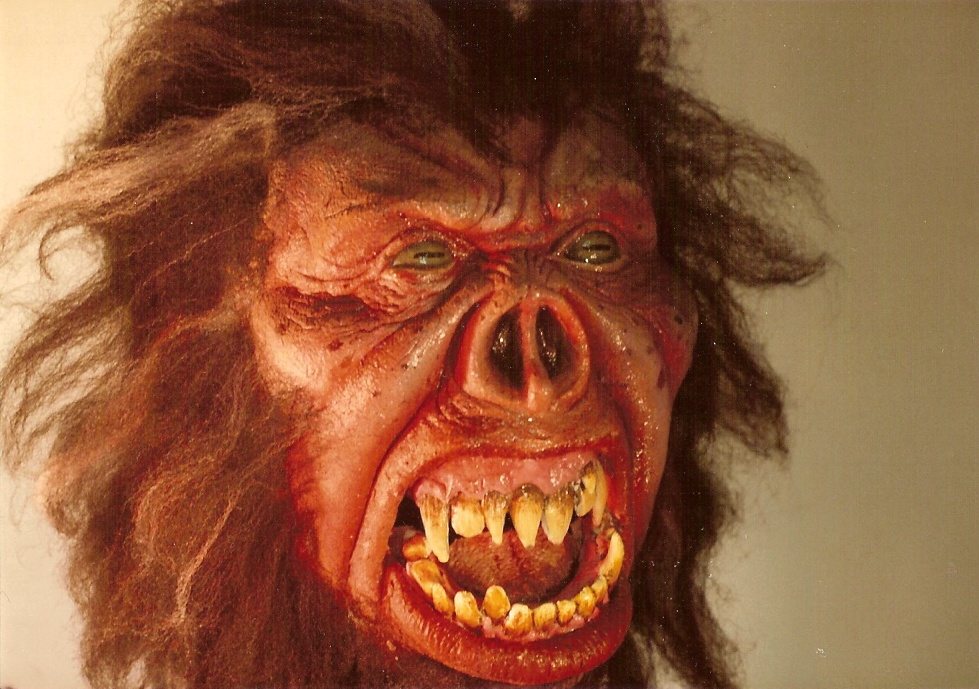
 I ended up sculpting one Ghost Soldier mask, but being too literal and not having enough experience to understand sculptural cheats, it ended up looking a little like "Molesar" from THE KEEP.

No, I was SOBER when I sculpted that!
 Finally, a couple of the on-screen actors showed up for life casting for a couple of specific effects.  Anne Bandcroft's son, Branford, was one of the cadets who was going to get stabbed in the chest with the fragmented arm bones left on a Ghost Soldier that had its hand blown off.  We cast his chest in order to produce and insert piece for a shot of the bones actually piercing the characters flesh.

Brandford's chest (one of my illustrations is on the wall behind it)
 We also cast actor Bobby Di Cicco (the dancing boyfriend from 1941) who was to be shot in the forehead.  Mark ended up making a DuPont Elvacite appliance for this effect.

Ed Ferrell and Mark also designed and rigged both the effect where a Ghost Soldier has his hand blown off with an M-16 machine gun, as well as, another shot where a Ghost Soldier has his jaw knocked off.  Both effects required crude, but effective soft urethane molds (Ad Rub).  We made one silicone mold on GHOST SOLDIERS, which by that time was being called by its release title THE SUPERNATURALS.  Silicone was extremely expensive and our humble project didn't have the resources to use the material the way it is used currently.  Because of this, only Bart's skeletal sculpting form was the only thing we molded in silicone and it became an investment mold that Mark would use for years to come.

Here's the Ghost Soldier that eventually lost its jaw.
Some of the "FX" arms made for the show.

The skeleton sculpture base is prepared for a silicone brush up mold.

The final silicone mold and...
Here's what you would get if you ran it!

 The four of us worked incredible hours, on an average about 16 hours a day and most of the time, 6 days a week!  On the one hand we needed the time to do the job correctly.  We produced something like 6 Ghost Solider costumes with corresponding gloves and masks.  Every suit was built using either Bart's or my sculpted rib form glued onto an under-suit.  I'd run foam latex (the Charlie Schram formulation), we'd spatulate it onto to the ribs and under-suit and then using texture pads and wood tools, we'd sculpt directly into the foam latex.

Sculpting rib "forms." Sheesh! I still shudder when I look at this photo.
 I recall that this was about the time that GREYSTOKE: THE LEGEND OF TARZAN, LORD OF THE APES had already opened in theaters and somehow, Bart had gotten a hold of a set of "Greystoke" texture pads used at Rick Baker's studio by the sculptors.  We molded the pads and then all ran a set for ourselves.  They were beautiful and PERFECT for the task at hand.

The foam was run, but now we had a new problem: Where the heck were we going to bake all of the suits?

(MORE TO COME...)


Sunday, June 5, 2011

Part 26: The Call That Changed My Life

Depressed. Bruised. Lost.  UNO was destroying what small shreds of artistic ambition I had left and those shreds were being tugged loose.  I sat in my small bedroom in my mother's tiny house, trying to figure everything out. What could I do?  I was certainly in a minority in school; everyone there had drunk the Kool-Aide and believed all of the crap that was being thrown around by the chimps in the Art Department.  Everyone else was so far away in California, which already seemed like another lifetime ago.

Maybe this was all happening for a reason.  Perhaps I was not cut out to be a Make Up Effects Artist and the Universe was revealing alternate plans for me, but how could I be sure?  I had to know, but how COULD I know?  Then it hit me.  I would write Dick Smith!  Of course!  THE godfather of Make Up Effects!  I put a package of photos together including my Waxman mask, and wrote Dick and asked him for an honest assessment of my abilities.  I knew Dick was good about writing back.  I had seen his letters sent to Mark Shostrom.  I made a promise to myself to respect whatever Dick had to say.

Dick, with a rouge's gallery of some of his creations
 I expected a letter; imagine how I felt when my mother told me that he was on the phone for me!

What a prince of a man!  So generous and, at that time, free with his advice.  He had, obviously, received my package and while he was thumbing through the photos, and decided to call to discuss them.  He liked the Waxman mask and thought that the other pieces showed a great deal of potential.  I asked if I should pursue a career in Make Up Effects, and he answered, "Yes, of course." I want to say he spent about 20 minutes with me on the phone giving me sculpting and painting advice.  He said he would mail me some important information about making prosthetic molds, etc. (and he did).  Finally, he excused himself, wished me the best of luck, offered to look over any new photos I had for review, and said good bye.

I sent this photo of the Waxman sculpt to Dick...

...and this photo of the final mask...

...and this sculpt I did for my "Jenifer" mask...
...and this creature design.

Ka-boom!

Suddenly, I didn't give a damn about what anyone at UNO had to say about my work.  I had advice from THE person that I needed to hear from.  Because he had taken the time to call, I was determined to put into practice the things that Dick had recommended.  I went back to work.  I purchased Roma Plastilina from Dixie Art Supply, built an armature and started to sculpt what would become my first foam latex mask.  And here's where working at Fox Photo came in handy - I brought the sculpture to my booth and would work on it during the day.

Honestly, I think most folks got a kick out of driving up to the booth and seeing someone sculpting a creature inside.  They still got their photos and with me distracted, there was less of a chance that I was perusing their vacation photos.

The nearest dealer of the mold-making stone Ultracal 30 was in Houston, TX and I would have to pay to have it shipped in across state lines.  The shipping cost three times more than the plaster itself!  But, I was doing it right.  I was following Dick's suggestions and refining my work.  The first beastie I decided to undertake was a Yeti foam-latex mask. 

I now understood the coring process and I figured that before I would attempt an overlapping prosthetic make up, I'd go with something easier.  I ended up sculpting, molding, coring, and running the mask out of R&D foam latex http://www.filmschoolrejects.com/features/blood-sweat-and-latex-home-schooling-shannon-shea-special-effects.php (for more information about R&D foam latex and my first disastrous attempt at running it).  The result was not bad for a twenty year old kid.

My Foam Latex Yeti Mask
Dramatic lighting never hurts...
 I was on fire!  I decided to attempt an overlapping prosthetic make up using my brother as a guinea pig.  I sculpted an evil monstrous visage but, because I didn't have Alcoat (which is a water-based separating agent) to coat my brother's lifecast, I followed Dick's suggestion of attempting to use plastic wrap to separate the sculpture into pieces and transfer them onto separate positives. It worked...kind of...

Putting the bald cap on...
Ready for the prosthetics...
Gluing the prosthetics down...
Basing the appliances...
Ready for hair application...
Laying the crepe wool hair...
Finishing the hair and adding color...
The final result was...well...unsatisfactory, but taught me more than I ever learned prior to it.
By this time, I had reached a price-ceiling at Fox Photo, and Tracy's father, John Fletcher, offered me a job to help him assemble and art direct a catalog for his oil field supply company, Driller's Electric of Harvey.  I knew nothing about how to do the job, but he insisted he'd pay more than Fox Photo and I would be drawing, technically.

I lifecast Tracy, but didn't end up doing a make up on her until years later...

I did end up doing SOME illustrations for his catalog, but most of the time I was handling the accounts payable department or putting job bids together under Mr. Fletcher's guidance.  At first, this felt like a step backward, however as I got older and became involved in the business side of creature effects, I discovered that my training at Driller's Electric had come in handy.

Still smarting from the failure of my overlapping appliance effort, I decided to go backward and produce a foam latex zombie mask made to fit my high school friend, Tim Guillory.  This time, I was a bit more pleased with the result -

Tim is wearing a foam latex mask, built up neck and crepe wool hair.
I was 22 years old and ready to enroll in my second semester as a Fine Art student when I received another call.  It was Mark Shostrom.  Mark had finally been awarded a film that required a larger crew than just himself and an assistant.  It was tentatively titled "Ghost Soldiers" and would shoot in November. It was the call that would change my life forever.  No longer would I fantasize about what it would feel like to be a Special Effects Make Up Artist.  I told Mark I could be in Los Angeles in two weeks.

I had crossed over the line, then; I was a "professional."